15 December 2025
By Madhri Yehiya
Contributing Writer
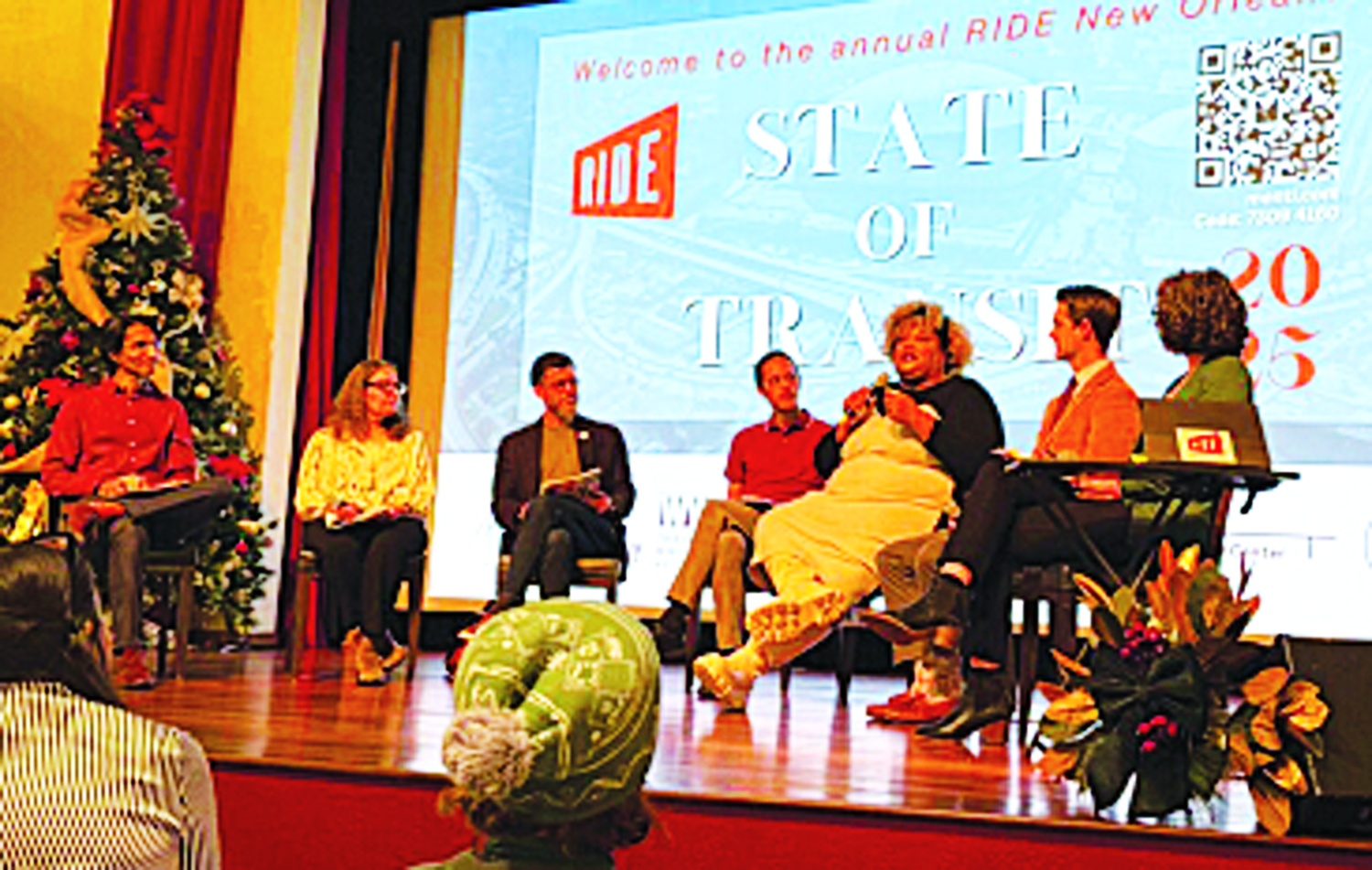
(Veritenews.org) — Public transport advocacy organization Ride New Orleans (RIDE) hosted its annual State of Transit event on Tuesday (Dec. 9), marking the release of the 2025 edition of the State of Transit report on how the city’s public transit system is performing and how it can improve.
This year’s program, titled “How Do We Build a Healthy Transit System?” brought together a panel of local experts and advocates to discuss pervasive issues and share recommendations for how the system can improve in the future.
The report discussed the evolution of public transit in the 20 years since Hurricane Katrina and the possibility for job growth by investing in the system. The report’s main recommendations are to improve communication from the New Orleans Regional Transit Authority and accessibility of the agency’s various forms of transit. RIDE found that alerts for detours and disruptions are often unclear, incomplete and often only shared digitally, and that many bus and streetcar stops and vehicles are inaccessible for people with physical disabilities.
RTA did not respond to a request for comment on whether it will implement changes based on these complaints in time for publication.
The free event was held at the National World War II Museum and moderated by Nellie Catzen, executive director of the Committee for a Better New Orleans and co-chair of the New Orleans Complete Streets Coalition.
Courtney Jackson, executive director of RIDE, said in an interview with Verite News that much of this year’s report reviewed systemic issues that have existed for years.
“We are hearing that riders need more access to joy, jobs and healthcare, and it has to do with [transit] reliability issues,” she said. “We tried to find the core of those issues and then build out from there.”
The New Orleans City Council approved a new budget in November, cutting $1 million from the $2.5 million Opportunity Pass Program, which offers free transit passes for youth ages 16 to 24 in Orleans Parish. In a Dec. 1 press release, RIDE said that the program will continue for the foreseeable future despite a drop in funding spurred by the city’s attempt to narrow a large budget deficit.
“We want to make sure that youth ridership knows that … they should keep using [the pass] like it’s not going away,” Jackson said.
At the event, multiple speakers highlighted how crucial the Opportunity Pass program is for young people who have no other option for getting to work, school, medical appointments and more.
Je’Miyah Suggs, 19, has been using the pass for a year. After the event, she told Verite News that she feels there is a scarcity of parking spaces and that she is saving on rideshare and potential car maintenance costs by using free public transportation instead. However, she added that the system could be expanded to include more stops along routes, and safer by shortening wait times.
“I think it should be accessible to [elders],” she said. “No one should have to wait more than 30 minutes to get where they want to go. … There should be more ongoing stops.”
Sierra Gaines has been using the opportunity pass since February. Although she has a car, she said having free access to public transit often provides an easier and cheaper way to get to work, classes at LSU and “places of joy.”
“Transit has made going to those places much more enjoyable because I don’t have to worry about all those situations around car parking and gas,” she said.
Gaines noted that the system is far from perfect, however. “There aren’t places for people to sit and wait in the weather, storms, extreme heat that New Orleans faces,” she said. “And when you have unreliable transit, it’s like, ‘OK I have this, it’s free to me, but I’m unable to use it.’”
Suggs, Gaines and Sam Strait, RIDE’s youth programs coordinator and another Opportunity Pass user, spoke on stage about the benefits of the program prior to the main panel discussion.
Since the program’s launch in September 2024, nearly 8,000 people have signed up for unlimited free rides on buses, streetcars and ferries in New Orleans. The report noted that over half of all users said they are daily transit riders and identify as Black or African American.
Panelist Vivek Shah, a transportation planner, consultant at Shah Planning and former RTA employee and former RTA employee, noted the important role that quality sidewalks play in resident access to public transit.
“Every person who rides transit starts and ends their journey as a pedestrian,” he said. “So if the sidewalk conditions suck, you’re far less likely to actually get to the transit stop in the first place.”
The report points to a case study from Denver, where this year voters approved a shift from property owners bearing responsibility for adjacent sidewalks to the city taking over maintenance. Applicable property owners will now be charged a $150 base fee that will generate millions in total for sidewalk construction and maintenance.
Shah said Denver’s sidewalk program can serve as a model for New Orleans. He added that there is no point in funneling taxpayer dollars into a public transit system that does not put safety first.
“If it’s not safe for your kid to walk to school, who cares how fast the traffic is, how little congestion there is? If that is not prioritized, then every other dollar spent on the streets is essentially funneling money into an already ineffective system,” he said.
The city’s Department of Public Works and City Councilmember Eugene Green, who chairs the City Council’s Transportation and Airport Committee, did not respond to requests for comment in time for publication.
Panelist Michele Seymour, director of the Reengagement Center at the New Orleans Youth Alliance, said that public transportation too often does not see the attention it deserves because of whom it impacts.
“The narrative around transit is that it isn’t seen as a priority because of who the perception of transit riders are, which are particularly low-income, Black and brown people – which also is kind of outrageous in a historically-black city,” she said.
Timothy Cardner, board chair and transit advocate for Ride New Orleans, said on the panel that he often pictures how difficult it would be to use a wheelchair or push a stroller or have another mobility impairment as he walks around the city.
“I think city leaders need to know that no world-class city is car-dependent,” he said. “If you look across the world, they all have high-capacity, beautiful transit systems that are frequent, reliable, accessible for everyone. And it’s not a stigma. People use it.”
Jackson said now that the report is out, members of the RIDE coalition will begin communicating with local leaders to advocate for their recommendations to be used to develop transit policy.
“Our goal is to bring world-class transit to the region,” she said. “We’ve got some steps to get there. We want to give [city leaders] the necessary steps to build
the foundation.”
This article originally published in the December 15, 2025 print edition of The Louisiana Weekly newspaper.