1 December 2025
By Wesley Muller
Contributing Writer
(lailluminator.com) — A refinery near Gramercy faces new allegations from state regulators after water samples taken from the facility’s Mississippi River outfall proved deadly to aquatic animals during a routine lab test.
On Oct. 24, the Louisiana Department of Environmental Quality issued a new “Notice of Potential Penalty” compliance order to the Atlantic Alumina Co. facility that refines bauxite mineral into a feedstock chemical used to make aluminum. The facility is the only one of its kind in the United States.
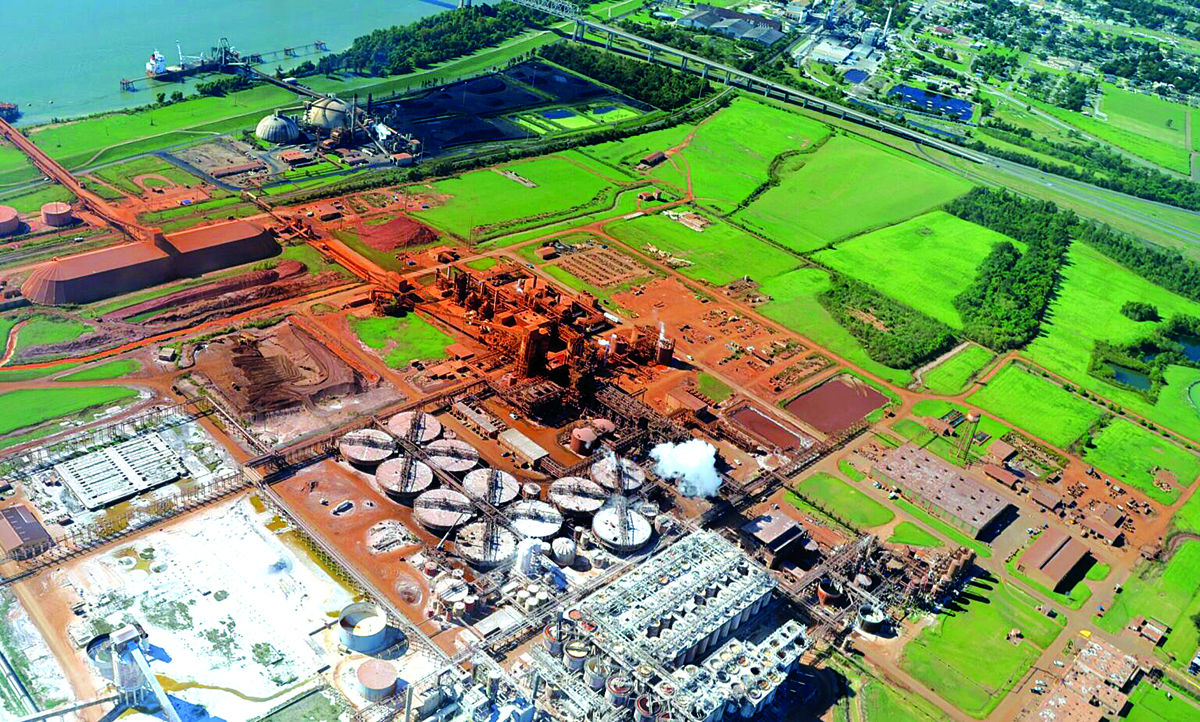
The notice serves to warn the company of potential penalties for alleged violations state inspectors documented during a recent file review and field visits conducted Aug. 8 and Oct. 17 following a citizen’s complaint. The document, which the Department of Environmental Quality published earlier this month, notes the Atalco refinery failed an effluent toxicity test of the discharges sampled from its Mississippi River drainage outlet. Performed every three months as a matter of routine, the toxicity test involves exposing minnows and crustaceans to various concentrations of the sampled effluent over a 48-hour period.
According to the test conducted Sept. 4, Atalco’s sampled discharges were significantly more toxic than what the state allows in the Mississippi River. Even at the lowest concentration tested, the sampled effluent began killing significant numbers of crustaceans. When tested at the 1.5 percent standard concentration at which the animals should still be able to survive, the effluent killed 64 percent of the Daphnia pulex crustaceans, better known as water fleas.
Atalco did not respond to a request for comment for this report.
Ahmed Harhara is a chemical engineer who runs a neighborhood-level environmental data website in the Houston area and is familiar with the toxicity tests used in refinery operations. He reviewed the Atalco lab results and said they are a strong signal of a serious problem at the facility.
“These tests are basically an early warning system,” Harhara said. “If fish or small aquatic animals don’t survive in the sample water, it means the effluent is too toxic – even after it’s been treated – and could harm life in nearby streams if released.”
Harhara pointed out that the method for toxicity testing is tailored to the specific water stream receiving the discharges. The test conducted for Atalco uses a dilution or concentration factor that takes into account the Mississippi River’s current and massive volume of water, meaning it would take high levels of toxicity to fail the test.
Nicholas Fisher, an environmental scientist who studies aquatic pollution at Stony Brook University and also reviewed the lab results, said effluent toxicity tests often understate the danger of the pollution.
“I would say they’re overlooking a lot of the toxicity,” Fisher said. “The stuff that’s in the effluent is probably far more toxic than they realize.”
When tested on minnows, the sampled effluent had no significant effect, but both Harhara and Fisher said that’s not surprising as the crustaceans are generally far more sensitive to many industrial contaminants. Also, fish are more mobile than small crustaceans and can swim away from areas of poor water quality, Harhara said.
It’s unclear how often facilities such as Atalco fail effluent toxicity tests. LDEQ spokeswoman Meagan Molter said only it happens occasionally, but had no relevant data available. The agency doesn’t track the test results in a global way, she added.
Harhara said toxicity test failures are infrequent at facilities with properly working treatment systems.
“In my view, it is newsworthy precisely because these failures are rare and measurable. They show where the treatment system may have slipped, even briefly,” he said. “It’s the kind of data point regulators and the public should pay attention to.”
On Oct. 21, just days before the Department of Environmental Quality issued the notice of potential penalty, aerial photos of the Atalco site showed plumes of discoloration in the river coming from the facility’s drainage pipe.
Aside from the toxicity test results, LDEQ’s notice cited large volumes of discharges with high pH levels that Atalco drained into the river at over 20 times the rate allowed under its permit.
When state inspectors visited the area on Aug. 8 and Oct. 17, they discovered public stormwater ditches and waterways filled with reddish-orange water. This included the Hope Canal, which flows to the Maurepas Swamp, according to the notice.
An Atalco representative told the inspectors the facility’s runoff containment system failed after it was inundated with sediment, and the runoff became contaminated with Atalco’s “red mud” waste, the notice states.
“The inspection revealed that the Respondent failed to maintain waters of the state in an aesthetically attractive condition and meet the generally accepted aesthetic qualifications,” the LDEQ notice said.
Atalco received a similar notice from the Department of Environmental Quality in August for separate violations stemming from erosion channels in the giant levees of Atalco’s red mud waste lakes. The fissures allowed waste slurry to escape from the facility and contaminate state waters.
Records the Illuminator reviewed indicate the facility’s waste byproduct contains toxic heavy metals and other hazardous chemicals.
The latest infractions continue a pattern spanning more than a year during which the company has struggled to contain toxic releases from its facility despite heightened public scrutiny over previous violations of environmental laws and workplace safety regulations.
This article originally published in the December 1, 2025 print edition of The Louisiana Weekly newspaper.